August 11th, 2026

Every AI reads the same open web. Be ahead, by accessing proprietary data.

AI made average research free. Every chatbot reads the same free web, so everyone gets the same answer at the same time. With Frames, your agents get access to premium, paywalled data.


Some information is only valuable while few people have it.

By the time something is a headline, everyone has it, and it's worth nothing to you.

People have always paid serious money to know things first. What changed is where the early information lives.

It used to live in networks: who you knew, which calls you were on. Today it lives in data, in hiring pages, filings, order books, forum threads, and traffic numbers, where the signals show up days or weeks before the story breaks. And most of that data sits behind paywalls.

Why your AI can't give you an edge

Here's the uncomfortable part: AI made research free, and that destroyed the value of average research.

Every chatbot reads from the same place: the free internet. Ask one what's happening in a market and you get a tidy summary of what everyone else already read. The same answer, at the same time, as everyone else asking.

If the information is free, you're already late.

The data that makes you early costs money: live market feeds, company and people databases, joined filings, full comment threads. No chatbot can cross a paywall, so none of it reaches your answers.

How the sharpest people actually use AI

The people getting real answers out of AI don't ask it to "research the market." They feed it the right inputs first: competitor sites fully indexed, earnings call transcripts, hundreds of customer reviews, and the complaint threads nobody reads. Then they ask the hard questions, and the answers come back sounding like a decade in the market.

The method works, but assembling those inputs is a grind of subscriptions, API keys, exports, and days of collecting before you ask the first question. That grind is why so few people do it, and it's exactly the part FRAMES-F1 removes.

A model that buys its own sources

FRAMES-F1 works like any AI you've used, with one difference. When your question needs data from behind a paywall, it finds the right source out of about 37,000, pays for just what the question needs (usually cents), and reads it on the spot.
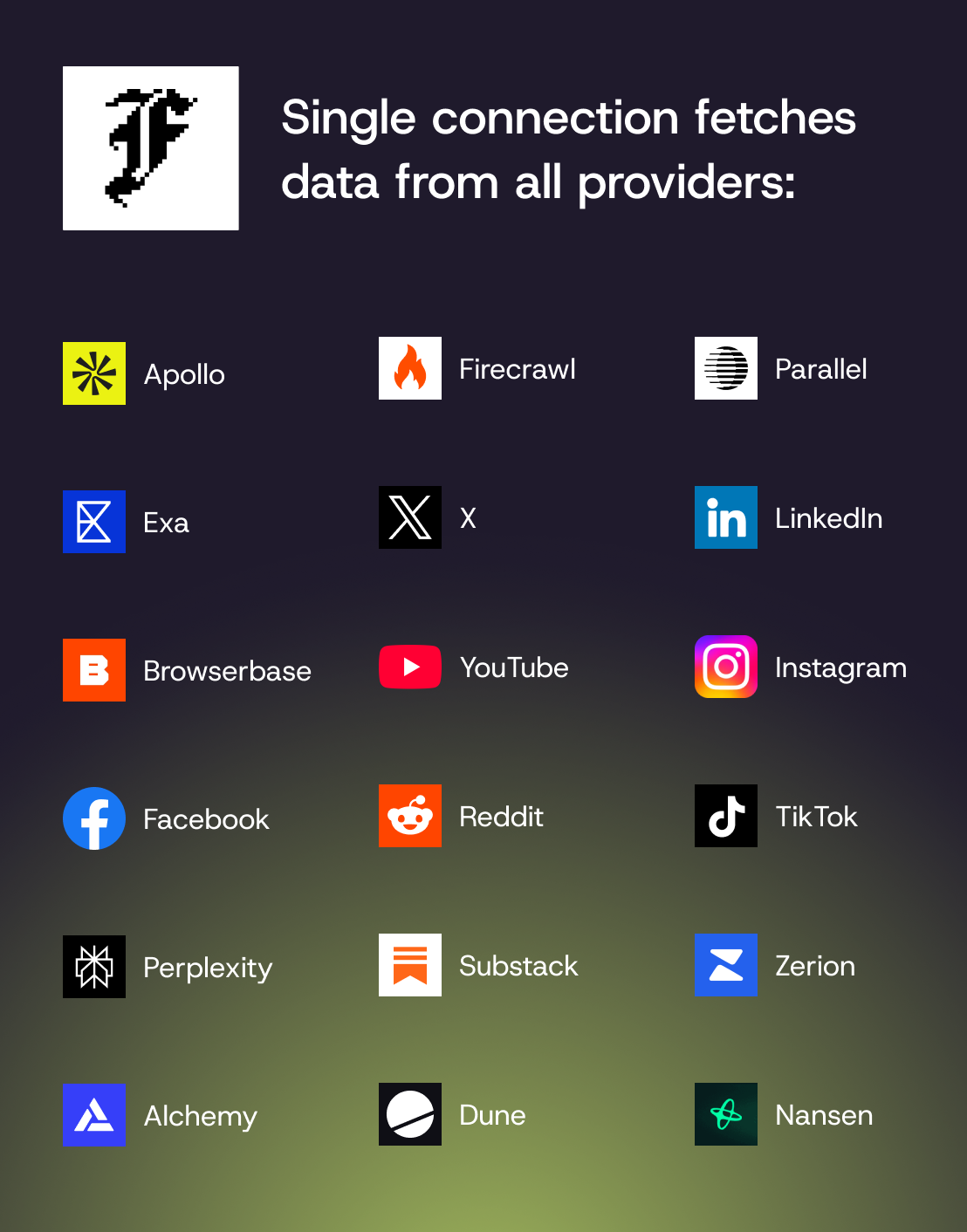
A sample of the paid data providers FRAMES-F1 routes questions to

Behind every question sits that catalog of providers: market data feeds, company and people databases, web-scale scrapers, social listening tools. F1 knows which ones actually deliver for each kind of task, because every paid call it has ever made taught it, and it routes your question to the best source automatically.

You ask in plain language, and it gathers what the question needs, cross-checks it, and answers with a link behind every claim, without you holding a single subscription, API key, or wallet.

And it doesn't trust sellers blindly. Every paid response is checked: empty results, hollow answers, and errors dressed up as success get caught. You're only charged when the answer clears an 80% confidence check.

Does the extra data actually show up in the answers?

We tested it in public. We gave the same live market question to F1, GPT 5.6 and Claude Fable 5, then showed each rival F1's answer and asked for an honest scorecard. Both graded F1's answer above their own, in conversations you can read yourself: the GPT 5.6 chat and the Claude Fable 5 chat.


ChatGPT
“FRAMES-F1 is materially better on data coverage. My response is somewhat better on analytical restraint, but still makes unsupported inferences and has a major unresolved data discrepancy.”
GPT 5.6, comparing its answer with FRAMES-F1
Claude
“Honest scorecard: Frames' output is better where it matters most, and one of my core conclusions doesn't survive contact with its data.”
Claude Fable 5, comparing its answer with FRAMES-F1
Prompt
Pull the live options chain for NVDA. Show me where open interest is concentrated across strikes and expiries, the put/call balance, and what the skew implies about how traders are positioned into the next expiry.

Notice what the rivals conceded: not smarter reasoning, but fresher and more complete data. That's the edge, and it compounds with every question you ask.

What people watch with it

The pattern is the same whether you're picking investments, trading a market, or just refusing to be the last person to hear about things. Real prompts people run:

Spot the trend before it's a headline

Funding, hiring, and traffic move weeks before the stories get written. Track the raw signals yourself and rank what's actually gaining momentum.

Example prompt
Map the AI coding-agent market: every company that raised in the last 12 months, headcount growth, web traffic trend, and who their customers are. Rank by momentum.

Go deep on one company or person

Turn a name into a full picture: the money, the team, the traction, and what customers say when nobody is marketing to them. Sourced, not guessed.

Example prompt
Build me a brief on Perplexity: funding history, headcount growth by function over the last 12 months, web traffic trend, current hiring focus, and the top complaints in user reviews and Reddit threads. Link every claim.

Monitor a field while you work

Pick a space and keep score: who raised, who is hiring, what shipped, and how sentiment moved. Catch the unusual thing while it's still unusual.

Example prompt
Watch the agentic-payments space: funding rounds, notable hires, product launches, and sentiment shifts from the last 14 days. Flag anything unusual.

Run the screens pros build by hand

Cross-reference public filings the way analysts do, without the week of spreadsheet work. Each filing is public. The join is the edge nobody publishes.

Example prompt
Screen every US-listed company for the fundamentals I care about, then show me where insiders are buying at the same time institutions are adding.

What it costs to find out

Starting costs nothing: the free plan gives you 3,000 credits a month, enough to run real questions against the full catalog of data sources, with no card required.

Ask it the question you'd normally spend an afternoon researching. If the answer isn't clearly ahead of what you get elsewhere, you've lost five minutes.

Being early is the whole game

Nobody gets ahead by knowing things at the same time as everyone else. The edge has always been asymmetric information, and it didn't disappear when AI arrived. It moved behind paywalls, and now it's one question away.

Test free

More from the blog

All posts